“Stories That Empower” Podcast
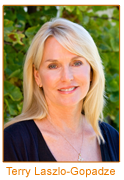
Thursday, May 17th, 2018Terry did a podcast with Sean over at Libsyn. You can listen to her story here: Terry’s Story
Terry did a podcast with Sean over at Libsyn. You can listen to her story here: Terry’s Story
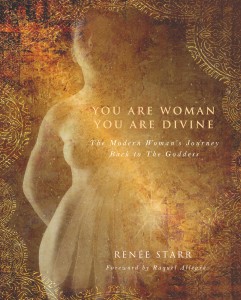 And the time has come, right now, for women to know that being female is special, sacred, and divine. This inspiring, poetic and magically potent book will entice women of all ages to explore and activate their relationship with the divine, feminine and most sacred part of themselves–the goddess within. In You Are Woman, You Are Divine, ‘Back to the Goddess’ founder Renée Starr takes women on an enchanting, empowering journey, offering ancient wisdom in a fresh, modern way to help woman reclaim all the beauty, grace, and strength that being female is.
It is such an honor to endorse this book:
“You Are Woman, You Are Divine is inspired. You can’t read it without feeling the presence of The Divine Feminine, the ancient goddess energy, moving in your bones. It is so beautifully written and woven together; I’m enthralled and I can’t stop reading it even though I should be packing for a trip. My suitcase sits empty as I turn the pages…filling my soul with much needed food. Women, we are being called home to our true, essential nature. By nurturing the timeless presence of Her, we realize She is already within us. Open this book and unlock the door to important myths, mysteries, goddesses and rituals that were lovingly chosen by Renée Starr. Her deep connection with The Divine Feminine leaps off the pages and enters the psyche in rich and meaningful ways. This extraordinary work brings us close to The Beloved, to Freedom and ultimately to honor our own Sacred–Self. I will give this book to my friends”.
– Terry
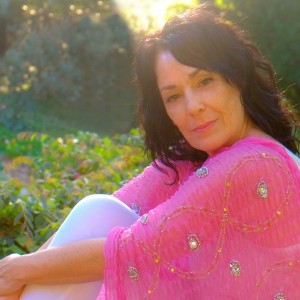 Read the Book. Join the Movement. Be a goddess on earth.
http://www.backtothegoddess.com/
https://www.pinterest.com/tothegoddess/
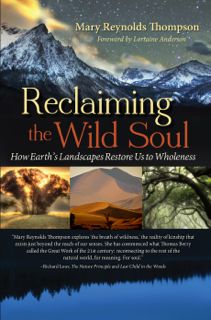 I am happy to announce that my good friend and colleague Mary Reynolds Thompson’s latest book Reclaiming the Wild Soul: How Earth’s Landscapes Restore Us to Wholeness is now available!!!
“Reclaiming the Wild Soul” is a must read for anyone looking for a joyous path to wholeness. Mary Reynolds Thompson’s superb book takes us back to our deep roots in nature where our dreams and destiny intertwine. Her book ignites the soul with the earth’s powerful wisdom and connects each of us to our deepest, wildest, wisest selves.”
— Terry
You can purchase a copy of Mary’s book here: http://www.amazon.com/Reclaiming-Wild-Soul-Landscapes-Wholeness/dp/1940468140
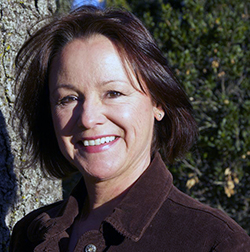 I was asked by Mary to share a story for her Wild Soul Story series. I can never resist telling a story and mine is about a healing from a pine tree! You can listen here: http://maryreynoldsthompson.com/terry-laszlo-gopadze-5/
Mary reminds us that, “ A wild soul story requires you to leave the well-worn path and enter the dark and leafy terrain of your imagination. It communicates in the language of poetry, metaphor, and nature.”
You can watch Mary’s book trailer here: https://www.youtube.com/watch?v=YCS_oWVbIjI&list=UUGHMYLdn1488aOY8XgsDJmQ
You can download your free Wild Soul Mandala and check out Mary’s schedule of workshops, readings and other events by visiting her website: http://maryreynoldsthompson.com/.
 Dear Friends,
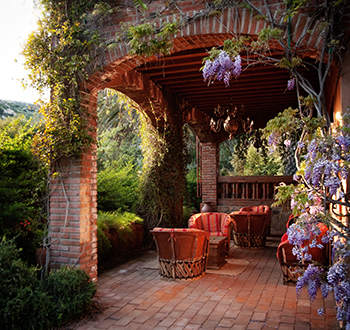
Join me at the world-class spa, Rancho La Puerta I would love to see you and share a magical week of restoring in nature, eating delicious foods, hiking, enjoying amazing fitness classes and wonderful presentations amongst interesting people. If you would like a discount please feel free to contact me.
Kind blessings,
Terry
Rancho La Puerta
June 14-21 2014
November 15-22 2014
“Celebrating Stories: Transforming Our Lives”
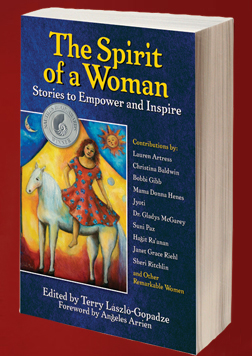
In her evening presentation, “Creating Your Destiny”, Terry Laszlo-Gopadze, editor of The Spirit of a Women: Stories to Empower and Inspire, will share stories from her book with the hope that they will inspire you to live your life with more meaning, passion and purpose. Each of us has a great calling, or dream. Our dreams, our longings and even our challenges can lead us to where we belong in the world. We are creating our future, whether we realize it or not, by the stories we choose to guide us.
 Author and poet, Mark Nepo, tells us of the importance of story, “Knowledge that matters, that helps us to live, comes to us through honest stories. And those only surface because of the courage of those who admit to the messy splendor of living.” Let’s gather together and celebrate the messy splendor of living!
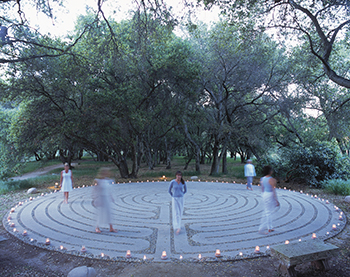
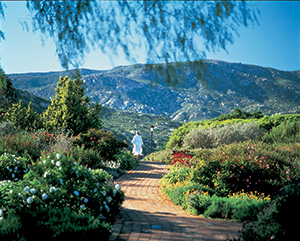
The weekday workshops will bring participants together to hear stories with the diverse themes: “Connections”, “The Gift in the Challenge”, “Changes and Choices”. We will gather in a circle to conceive, compose, and tell stories, while being offered ideas to start your own stories. In our final session, we will carry our stories in to the Labyrinth in the Ranch’s oak grove. Every story has a gift. What will yours be?
 Dear Friends,
Join us for a week in nature and enjoy every offering a world-class spa (www.rancholapuerta.com) can provide. Mary and I would love to see you and share the beauty, fitness, healthy food, interesting classes, and fun people at this magical resort. If you are interested in special discounts, please feel free to contact me.
Be well,
Terry
“Embracing the Wild” with TERRY LASZLO-GOPADZE and MARY REYNOLDS THOMPSON
October 5–12, 2013
In the evening presentation, TERRY LASZLO-GOPADZE, author of The Spirit of a Women: Stories to Empower and Inspire, and MARY REYNOLDS THOMPSON, author of Embrace Your Inner Wild: 52 Reflections for an Eco-Centric World will explore our relationship with “wildness” as it lives inside and outside of us. Each author will offer their stories and reflections about how our own wild nature empowers and heals our selves and our planet. In the workshop series, Mary and Terry will offer up techniques and inspiration to help you explore and create your own wild stories. Join other participants and discover the gifts that wildness brings to you.
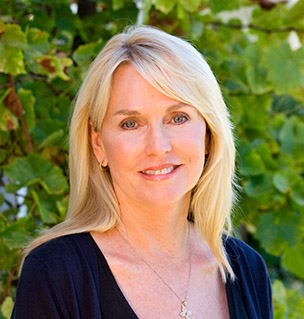
Terry Laszlo-Gopadze
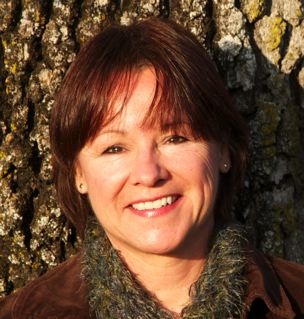
Mary Reynolds Thompson
Original post: http://stylesubstancesoul.com/2013/04/the-spirit-of-a-woman-and-terry-laszio-gopadze-by-amy/
StyleSutstanceSoul has given me many gifts. I have had experiences I never would have had otherwise, been exposed to movies and products I would never have known about or known I cared about; but, most important, are the amazing women I would never have known had it not been for the site.
Terry Laszio-Gopadze is one of those women. I was introduced to Terry by a mutual friend Uli Heine, Director of Development at PCI, a fan of the site and an amazing woman herself. The first time I met with Terry we talked as if we were long time friends who hadn’t seen each other in awhile rather than as the total strangers we were. Terry is very sweet, open and calm, which made sense when I found out she is a licensed Marriage and Family Therapist.
Through our conversations and e-mails I learned that she is a giver, of herself, her time and the knowledge she gains from others. She has spent her personal and professional life giving to at risk women through her many acts of charity and especially through her tireless efforts with the organization “Leap to Success.”
Uli thought Terry and I would connect and she was right. She also thought all of you would appreciate Terry’s book, “The Spirit of a Woman;” right again. I am not usually your go to person for book recommendations, as I am not much of a reader; but I hope that in this case you will make an exception. Terry’s book is a collection of short stories, inspirational stories, written by women for women about their own personal and innately female experiences. The book is divided into five sections: Connections; Creating My Destiny; The Gift in the Challenge; Changes and Choices; and Divine Interventions.
Each of these intrigued me and sounded like contemporary twists on “Passages” or at least the stages of my own mid-life condition. My first inclination was to say “mid-life crisis,” but I imagined Terry gently guiding me away from that negative term toward a softer description. I considered situation, but settled on condition, which I think Terry would approve of and that those of you who are in a similar stage of life will relate to.
I can clearly hear her using those five book section titles to more positively describe my negative descriptions of my own emotional state or “circumstances”. I would say I am suffering and struggling with a lot of loss in my life: the loss of my Dad; the loss of my children no longer living at home full time; and other losses in my personal and work life. Terry would describe these losses as “Changes and Choices,” perhaps even “Divine Intervention” in the case of my Dad’s sudden and untimely death.
I might say I am having difficulties with aging in general, and specifically aging in the work place, and with feelings of being obsolete as a full time mother. Terry would encourage me to look for the “Gift in the Challenge,” for new ways to make “Connections,” to “Create my own Destiny,” and she would be right. The experiences of the women who tell the stories in Terry’s book tell me the same thing and give me great examples to learn from.
I asked Terry why she thought the stories in “The Spirit of a Woman” were important. This is what she said.
“The stories of the women who triumph, even in adversity, help us to discover the places inside ourselves that we may not get to on our own. In “The Spirit of a Woman,” we meet women of diverse backgrounds whose stories inspire us with their strength, courage, resourcefulness and authenticity. Their stories remind us of the goodness and greatness in being human.
Stories of hope and transformation help us to remember that we have the freedom to choose. We can choose to follow our rhythms, to speak our truths, and to be faithful. We are always creating our lives based on the stories we choose to guide us. After all, storytelling is the most ancient soul retrieving, healing art on the planet.”
 The Spirit of a Woman was a finalist in the anthology section of the National Indie Excellence Awards!
I’m very grateful to all the authors and other wonderful contributors to the book!
The competition is judged by an independent experts from all aspects of the indie book industry, including publishers, writers, editors, book cover designers and professional copywriters. They select award winners and finalists based on overall excellence of presentation.
With joy and celebration,
Terry
 I am happy to announce that The Spirit of a Woman was a Finalist for the Eric Hoffer Award!
–Terry
Excert from HofferAward.com:
“After our rigorous first round of judging, less than 10% of the titles become category finalists. We consider this a distinction of its own merit and, in 2008, began officially listing these titles on-line. Finalists are selected by category scoring. There are typically 1-6 books per category selected as a finalist. Finalists fall into approximately the upper 10% of all books that entered the contest. Below are the current and previous category finalists in alphabetical order by book. (Please click here to view the Montaigne Medal Finalists, da Vinci Eye Finalists or First Horizon Award Finalists.)”
When Venus passes directly between the Earth and the Sun, we see the planet as a small dot passing slowly across the face of the Sun. Edwin Hubble described this transit as “the most noble event in astronomy.” It is a rare event that occurs in pairs, eight years apart. The first one of this pair was in 2004 and the second will occur on June 5 or 6, 2012, depending on your location. Observers in North America see it the evening of June 5. The next one won’t occur for over a century, in 2117.
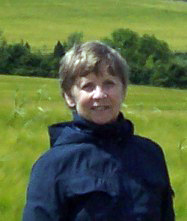
Sheri Ritchlin
Sheri Ritchlin has posted material on the subject which explores the deeper meaning of the transit in its relation to the Mesoamerican Quetzalcoatl-Venus (Mayan Kukulkan) and the birth of the Sixth Sun in 2012 according to both the Nahuatl (Aztec-Toltec) and Mayan Calendars.
The website link is at www.SheriRitchlin.com
For more info on when and where it is visible, you can go to
http://www.transitofvenus.org/
—
Enjoy,
Terry
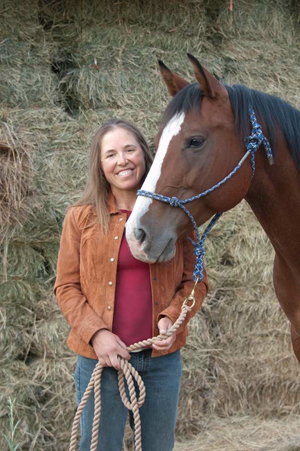 Brenda Reynolds Embraces Life with Horses
Brenda Reynolds gives credit to horses for saving her life and lifting her out of the grip of anorexia. She reminds us that through the presence and insights of animals we can heal, find inner peace and be filled with a sense of wonder. Now Brenda is dedicated to bringing the amazing spirit of horses to teenage girls. Why not share the gifts she has garnered from horses with others?
I thought you would want to read her article published in Horse Connection Magazine – Click Here to Read Her Article
With deep joy for all that Brenda and horses have to share with us,
Terry
REMEMBERING EVE
Sheri Ritchlin
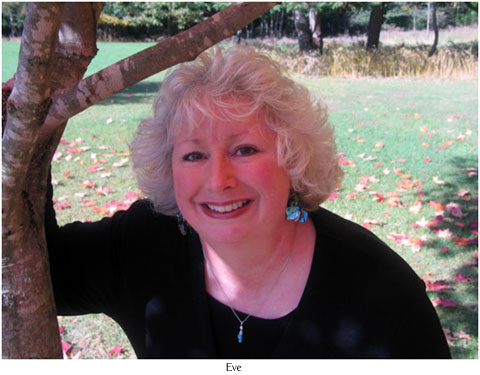
We had agreed to meet at Hicks & McCarthy’s on Main Street in Pittsford. This was a trip down memory lane for me. I was back in my hometown in New York State, going to the “soda fountain” where kids hung out as teenagers. I could hear my father’s voice warning us not to become “drugstore cowboys,” hanging out at Hicks & McCarthy’s—a place that sold only sodas and sandwiches. Were there ever such days?
The place had become a nice restaurant over the years and I was meeting Eve Strella for the first time. I have lived in California since 1966 and was back for my niece’s graduation. My sister, Robin Wilson, lives with her family in the old house now and my brother, Christopher Ritchlin, lives with his family in Canandaigua. My sister knew Eve through their mutual work as life coaches.
We sat in the back, sipping sodas, and hours passed. Eve was wearing a baseball cap and looked as sharp as can be. And indeed she was. Sharp, bright, vivid, and streaming with an unquenchable light—even after months of surgery, chemotherapy, and days on end in doctor’s offices and hospitals. She had far more energy than I did during that afternoon. I was still flagging from jetlag and I don’t think I even had that kind of energy before I left California. She admitted that she had been unable to attend a luncheon earlier in the day because she hadn’t felt up to it. I felt privileged.
People talk about having a positive attitude, but in Eve, this was something much larger; a quality that almost defies comprehension. She talked about the wonderful things in her life, and about her beloved partner, soon-to-be-husband, Ed Ribson. They had built an observatory—Stardust Observatory—in their backyard and she invited me to come by to see it, if I had time. We discussed cosmology and quasars and the world swelled outward around us, far far beyond Hicks & McCarthy’s. She showed me the jewelry she was making, and promised to make a pair of earrings for me. She had a shop nearby where she sold her jewelry, ceramics and wall hangings. She wrote articles and did her work as a life coach. And then there was the book she was putting together of stories from cancer survivors. It became clear to me, little by little, that Eve had stage 4, terminal cancer and was not in denial of it at all. “I just don’t intend to be stamped with an expiration date,” she said. She lived each day as a special and exceptional experience.
The purpose of our meeting, beyond getting to know one another, was to plan two book-signings in Rochester for Terry Laszlo-Gopadze’s book The Spirit of a Woman. Since both of us had stories in it, we decided to do this together and she had made the arrangements. I had worked as an editor on the book and remembered very well when Terry sent me Eve’s story to consider for inclusion in it. I had been deeply moved and impressed by the story so I answered with a resounding,” Yes”. I really wanted to meet the woman who had written that story when I discovered that she lived in my hometown back east.
Eve’s story in The Spirit of a Woman was not about her cancer. That came later. It was about the death of her husband, of twenty-two years, which came upon her unexpectedly when he entered the hospital for heart surgery and died that night. It was a searing experience, and Eve wrote the story in a way that any woman who has been through it can identify with. It is a story that “empowers and inspires”—the subtitle of Terry’s book.
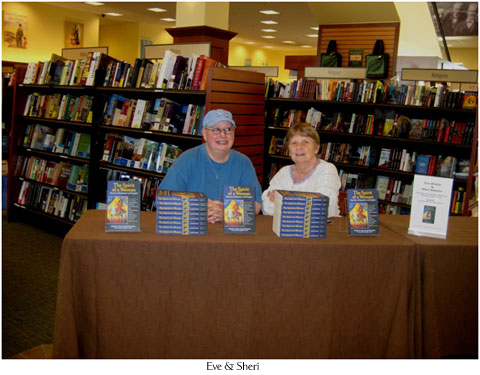
We were in touch after the book-signings. Eve emailed me in August—
“Sorry for the delay on this … time flies. I thought you might be interested. Go to www.rochesterwomanmag.com, then go to page 43…let me know what you think.”
Hugs,
EVE
The interview with Eve in Rochester Woman Magazine was indeed something else to be proud of. I just tried to follow the link again and found that the article is no longer up, so I wrote to the publisher, Kelly Breuer, and she sent this reply.
“I did not know that she passed away, and that tremendously saddens me. She was an AMAZING, A+++++ lady. She will be truly missed. I will be more than happy to send you the article as a pdf/jpeg file for you to use as you wish. We would be honored…”
You see how she touched people. I will include that article below when it arrives.
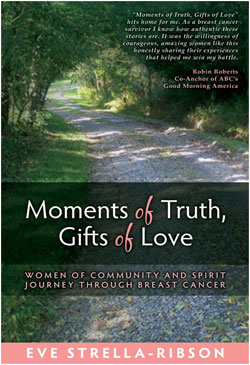 In March of this year, I heard from Eve again, asking me to take a look at the press release for her cancer survivors book. My jaw dropped. The cover was beautiful and carried a comment by Robin Roberts, co-anchor of “Good Morning America.” The title was Moments of Truth, Gifts of Love: Women of Community and Spirit Journey Through Breast Cancer.
Now keep in mind that all during this period, this was a person with Stage 4, terminal, cancer. By the end of May this year, she was back at Barnes & Noble in Rochester for a book-signing for her new book.
Eve’s book is a collection of stories of cancer survivors. Eve is not a cancer survivor. She passed away on July 19, 2011. The stories in Terry’s book all come to insightful conclusions. Eve’s final story does not. Yet it is all the more inspiring and empowering. She bears witness for us that life can be lived powerfully, lovingly and gracefully even on the downswing—whatever form that takes. From the beginning, Terry was looking for stories for her book from women who had converted hardship into blessing, in all of the myriad ways people are challenged to do this. You could say that Eve’s final story has no satisfying ending, but it does. In her passing, Eve has given us the ultimate insight:
The spirit has no expiration date.
Long live that fine spirit.
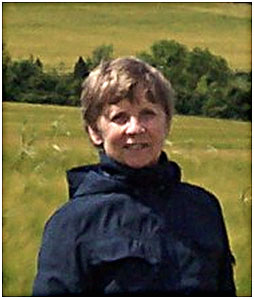
SHERI – BIO
The following poem was very important to Eve because David Whyte had written it for a friend who was dying of cancer. It speaks of death as the beginning of a journey instead of a departure. The poem resonates with Eve’s indomitable spirit and courage and it gives us all hope for our own journeys.
With love and appreciation for a captivating and heartfelt woman,
Terry
The Journey
David Whyte “The House of Belonging”
www.davidwhyte.com
Above the mountains
the geese turn into
the light again
painting their
black silhouettes
on an open sky.
Sometimes everything
has to be
inscribed across
the heavens
so you can find
the one line
already written
inside you.
Sometimes it takes
a great sky
to find that
small, bright
and indescribable
wedge of freedom
in your own heart.
Sometimes with
the bones of the black
sticks left when the fire
has gone out
someone has written
something new
in the ashes
of your life.
You are not leaving
you are arriving.
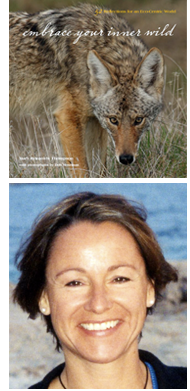 This is the title of an up and coming book by an inspiring woman, Mary Reynolds Thompson. Mary invites us to connect with earth’s spirit and wisdom in fresh and meaningful ways. She calls us to renew our relationship to earth while we make commitments to heal the natural world and ourselves. I had to introduce you to Mary. Mary is calling us home.
I wanted to share Mary’s wonderful newsletter with you as well. I’m signing up! Join me.
Click Here
With gratitude and reverence for our planet,
Terry
“Of a certainty
the man who can see
all creatures in himself,
Himself in all creatures,
knows no sorrow.”
-EESHA UPANISHAD
Spring is a season of many delights. Including the creatures who appear in our yards and the feast of flowers in full splendor. I’ve seen red fox, quail, coyotes, hawks, raccoons, hummingbirds, and most recently two doves came to nest in our rose bush. I wake up in the morning to cooing. I also met a rattlesnake.
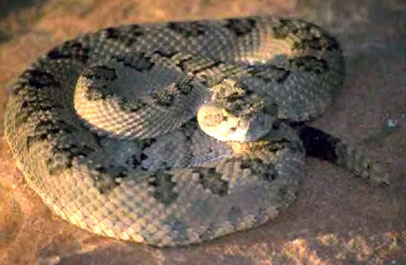 As I was stepping into the yard a few days ago a young rattlesnake was less than a foot away from my foot! I backed away and watched this small snake and tried not to be afraid of it. I wanted to bond with this messenger (as I believe all the animals that come to us are messengers). I searched for the shamanic meaning of snake to find they symbolize rebirth, renewal, transformation, wisdom, healing, and primitive energy. I told my husband if the snake would have bitten me, I could have died and then been reborn, renewed, transformed and healed! But seriously, I knew intuitively that there was a message for me. Like the snake, I need to shed some things in my nature and some relationships that really aren’t working for me at this point. I also needed to trust that the beautiful qualities snake was bringing to me were moving into my life.
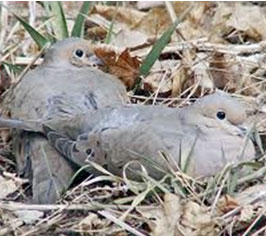
When the two doves decided to build their nest above our barbecue, my husband and I decided that we would give up the barbecue so that they could have a smoke free environment. Everyday we look to see if they are still in their nest and safe.
 Doves symbolically remind of the importance of peace. Deep peace. The kind of peace that helps to calm our worries and our troubled thoughts. They remind us to renew in silence. In our moments of stillness are able to find and appreciate the simple blessings. Doves represent the ability to see new possibilities.
As the doves arrived and built their nest, I received this wonderful little story from my friend Jacque Rice Jensen. I had to share it.
SPRING …….. LOVE OUT ON A LIMB
 The things that go on in the tree right outside my bedroom window never cease to amaze me. A few days ago the antics of two young doves diverted my attention for a few moments. Sharing one small limb, they were a “couple”, or perhaps they were about to become one. Sitting rather sedately, side by side, he reached over to give her an adoring peck. She radiated pleasure. Then without warning he grabbed her beak into his, swung her off the limb and onto the side he’d been perched on! He then attempted to jump onto her back, a movement that caused him to lose what little grip he had on the situation. Sputtering and fluttering he fell off, barely catching the limb with his toes!
She however, had maintained total calmness throughout, landing gracefully, with barely a feather out of place! Though she did give him a small look of bewilderment, as if to say, “What were you thinking, Dovie?”
When last I looked, they were still sitting side by side like an old married couple, appearing content with what was, while around them all the other birds with no demonstrations of judgment continued their joyous hymns to spring.
Are there any qualities of the snake or dove that you can would like in your life? Then take a moment to reflect or meditate on each quality and what action you can take to call them in.
 rebirth
transformation
renewal
primitive energy
wisdom
stillness
calmness
new possibilities
shedding
Like St. Francis said, “You are that which you are seeking.”
May your path be blessed,
Terry
 The Spirit of a Woman won a Silver Nautilus Book Award! My heart opens every time I think of it. I’m grateful for all the people who supported me along the way when this book was just a seed and yet they encouraged me, helped me, and kept me inspired when the road was difficult and I lost my way. This reminds me to do the same, to nurture people who come to me with their dreams. To give them what I can, for we are all a community of gifted, talented and creative people and I want to pass on all that I have been blessed with. I share this award with the contributors of the book and my tribe. Like Dr. Glady’s McGarey says, “We need each other.” Each of us are miracles.
Nautilus Book Awards recognize books that promote spiritual growth, conscious living, and positive social change, offering the readers “new possibilities” for a better life and a better world.
Winners are carefully selected in a unique three-tier judging process by experienced teams of book reviewers, editors, authors, librarians, bookstore owners, and leaders in the publishing industry. Previous winners include Deepak Chopra MD, the Dalai Lama, Eckart Tolle, Huston Smith, Marianne Williamson, and Andrew Weil, MD.
http://www.nautilusbookawards.com/ The Spirit of a Woman is in the Women’s Interests Silver Awards category.
With celebration and gratitude,
Terry
 Uplifting words expand your heart. Our Mother’s Day Top 12 Book Pick List is filled with inspirational books that are ideal gifts for your mother or yourself. Enjoy this special day together – and share a heartfelt book! Save this list all year round! A great book resource for you.
Read Spirited Woman’s Top 12 Mother’s Day Picks Here >
Copyright © 2024 The Spirit of a Woman. All Rights Reserved. Artwork Courtesy of Nichola Moss